|
Bulletin of Applied Computing and Information Technology |
Refereed Article A4: Auto-Identification Technologies: RFID vs Barcode in the Supply Chain |
|
04:02 |
|||||||||||||||||||||||||||||||||||||||||||||||||||||||||||||||||||||||||||||||||||||||
Peter Karlsson & Judith Symonds Karlsson, P., & Symonds, J. (2006, October), Auto-Identification Technologies: RFID vs Barcode in the Supply Chain. Bulletin of Applied Computing and Information Technology Vol. 4, Issue 2. ISSN 1176-4120. Retrieved from ABSTRACTRFID technology is new to the public domain. It was initially developed in the 1930s by the British during World War II. RFID technology gained little interest in the business arena and as a result further development of the technology progressed at a slow pace. Because of this, RFID has been associated with high costs and is still considered a relatively immature technology. KeywordsSupply chain management, auto-identification technologies 1. INTRODUCTIONIndustry observers believe that RFID technology will revolutionise New Zealand industry, but standards and maturity issues have to be reconciled before implementation takes place. Companies should consider the cost of the whole application rather than the cost per tag. Although the cost per tag is estimated to drop to as low as five cents per tag, analysts cannot seem to determine if the cost of RFID tags will decrease to that level. RFID is a concern in business also due its high failure rates and standardisation is still an issue due to the high number of standards that are present. RFID development also increases tension between industrial control and privacy concerns in the public sector. In this paper, we will explore such issues reported in the literature in an effort to bring together at least some of the information about the application of RFID technology in supply chains. From this understanding, we attempt to look forward to future applications of RFID technology in business. 2. RFID COMPARED TO THE BAR CODERFID is often said to be an alternative to today’s product bar codes. It may seem that the advantages of using RFID are already accomplished by bar codes, but bar codes have limited capabilities according to Sarma (2004). Bose & Pal (2004) mention that generally much of the data currently collected is inaccurate because of human error. RFID has a much larger potential in terms of data capacity and less human involvement the data collection (Hoc et al., 2005). Even though RFID systems generate advantages, RFID will not totally take over from existing bar codes. Bar codes will still be very effective at quickly and accurately identifying products even in the future, and at a very low cost (Lucket, 2004). Piasecki (2005) criticises proponents that only talk about the long-term benefits and “the death of the bar codes”. Bar coding is a mature technology while RFID is relatively new. But at the same time he adds that these proponents have changed their arguments in recent discussions to more realistic approaches that include the shortcomings of RFID. The RFID tag and the RFID reader can be compared to the bar code system’s scanner and bar code label. Instead of the bar code label, the RFID tag is attached to objects. A main difference between the RFID tag and the bar code label is that the RFID reader can read the information on the RFID tag without any line-of-sight requirement. Because of this feature, the RFID system can collect information relatively automatically. Garfinkel & Rosenberg (2005) mention that every scan of the bar code has a hidden cost associated with it due to the need for manual work, where RFID systems will remove these manual tasks. Each RFID tag potentially could be read more times during its lifetime compared to bar codes, which are read only once (at check out). In addition, because of the lack of line-of-sight requirement, it is possible to read multiple RFID tags at the same time because the RFID reader is independent of the RFID tags’ orientation. Lucket (2004) credits bar codes with creating limitations in business processes saying that many business processes are optimised as far as the bar code will allow. Every RFID tag is given a unique identification number (or more information). Bar codes are unique to a product group. If individual products were to be uniquely identified using barcodes, each bar code pattern would be too wide for the label (Sarma, 2005). As can be seen in the benefit analysis of barcodes and RFID tags (Table 1), RFID is capable of uniquely identifying products without running out of storage space. In some cases the RFID reader is capable of writing information to an RFID tag. For example, the RFID tag could store temperature, pressure or other potentially critical data that would be useful to store with the product rather than in an application. Table 1. Benefit-analysis (RFID vs Bar Code)
The aim of this paper is to review the literature on Auto Identification Data Collection Technologies (AIDC) with regard to likely paths of diffusion for RFID technology and integration with barcode technology. We suggest that RFID will follow a path of technology diffusion, defined by Fichman (1992), as a process where structural and cultural constraints interact with public demand to shape the diffusion of a technology. For example, analysis of the diffusion of telephone technology shows that initially the telephone was thought to be used for information exchange. The social benefits were not recognised by the telephone companies until many years later (Fischer 1988). Therefore, we predict that initially RFID will be used in the same way as preceding barcode technology. Eventually it will be transformed by its interaction with organisational structures and culture. 2.1 Auto Identification Data Collection TechnologiesAuto Identification and Data Collection technologies have made applications of data collection convenient through the use of bar codes and magnetic stripes. In supply chains, the bar code has contributed to an increase in efficiency. The ability to identify, track and control parts, and to improve business processes has been useful (Campbell 2004). RFID is a relatively new AIDC technology for use in supply chains, but has been used by early adopters in supply chain applications for the function of tracking and tracing items. Tracking and tracing have both been used to get more information from products in the manufacturing line, in warehouses for inventory control and in distribution applications. Recently, business has shown rapid growth in interest in RFID. There has been an increased belief that the earlier technological problems with RFID can be solved and RFID has probably the most potential to change business in the future compared to other technologies. The RFID tags are not just getting smaller, but are getting more powerful, storing more information, containing more intelligence; solving many more problems where bar code are currently being used (Heinrich 2005). Bar coded pallets and packages are already in use today to track items along the supply chain. But RFID and the bar code have some major difference in business, including improved visibility in inventory, accelerated supply chain speed and more meaningful exchanges of information between business partners. Estrin (BusinessWeek 2004) says that sensor technology has been around for a while, but the RFID system differentiates itself from previous systems by using many more sensors. These sensors are smarter and could be wireless and networked together. Therefore, businesses could monitor product location in a more precise manner. In this way, RFID can enable an end-to-end view of business processes that span across companies. 3. RADIO FREQUENCY IDENTIFICATION, RFID3.1 RFID TagThe RFID tag (transponder) is the component of an RFID system that is attached to objects. The RFID tag contains information which varies depending on the type of the RFID tag that is used. RFID tags come in many shapes and sizes designed for varying applications. For example, used under the skin of an animal compared to tagging of large, expensive medical equipment. A typical RFID tag is built from three components; an antenna, a chip and some encapsulation material. There are three different types of RFID tags. The passive tag is the simplest tag and stores an ID number. Passive tags require radio energy from the reader to send information. The passive tag has a long lifetime (decades) and is low in cost. Alternatively the semi-passive tag is similar to passive tags but a battery is incorporated into the tag itself. This contributes to an increase in reading reliability, but also gives the tag a shorter lifespan. The active tag is referred to as a ‘smart tag’ and is the most expensive tag (Heinrich, 2005). This type of tag is more reliable and has a greater reading range. Unfortunately, the active tag has a very short lifespan (years), mainly due to its continous transmission of a radio signal. RFID tags are categorised into different classes by EPC standards depending on reading and writing capability of the tag (Table 2). Table 2. EPC RFID Classes (Garfinkel & Rosenberg, 2005)
3.2 RFID ReaderThe RFID reader receives the information from an RFID tag, through radio wave transmissions. Different RFID readers use different frequencies of radio waves which can be seen in the table below (Table 3). Many of the early RFID readers could only read a specific type of tag. Currently, multimode readers are being developed to read different tags and are becoming increasingly popular (Garfinkel & Rosenberg, 2005).
Table 3. Band Frequency, reading range and application (Garfinkel & Rosenberg, 2005)
The RFID readers can be both handheld and static. Static readers can be used to read items where humans cannot go or cannot easily access, for example, many items loaded on a pallet (Heinrich, 2005). 3.3 Technological IssuesThere are three main technological issues that RFID systems face. Firstly there is the failure rate. Currently RFID faces several problems regarding the average failure rates (inability to properly program and read the tag) which is anywhere from 10% to 30% (Piasecki, 2005). This issue has to be considered if companies want reliable automation according to Sarma (2004). Secondly, there is interference. Often the readers have problems reading RFID tags because of surrounding materials. Radio waves cannot penetrate water or metal. But Piasecki (2005) points out that better placement of the tags may minimise interference. Finally and possibly the biggest hurdle for RFID is the cost, according to Piasecki (2005). The cost is supposed to be seen as proportional to the RFID tags area according to Sarma (2005). Analysts seem to agree that five cents is the number at which the potential Return On investment (ROI) falls into line with the costs of implementation. But analysts cannot seem to agree on when, if ever, RFID tags will cost that little. However, a relatively high cost per tag may be tolerated when tracking a valuable asset within a closed system (iStart, 2004). 3.4 StandardisationBusiness history has shown that agreement on standards is important. Standardisation gives companies more benefit from the information received. Standards also allow systems originally developed for closed-loop operations inside a company to easily become part of an open-loop architecture that spans company boundaries. But for RFID, standardisation is still an issue and business might feel confused when different types of standards are present. The EPC Network is supposed to make it possible to uniquely identify objects (Staake et al., 2005), but even this organisation has issued six drafts of RFID tag standards aimed at supply chain customers alone. Also companies are continuing to produce proprietary tags or identification schemes slowing the adoption process down. 3.5 Privacy ConcernsA tension exists between industry control and privacy concerns (Gunther & Spiekermann, 2005). Consequently organisations have been formed around the world to stop the RFID development. RFID has the potential to affect individual privacy according to Molnar et al. (2005). Some critics call RFID tags “spychips” and have fears of Wal-Mart’s “push” to use RFID in grocery stores to trace products to the end customer (Albrecht & McIntyre, 2005). 4. RFID AND ITS APPLICATIONAccording to Bose & Pal (2005) using RFID is supposed to be the next big wave to hit the supply chain. Even though logistics and the importance of the supply chain are not new ideas, it was not until recently have business realised the benefits of having a well-organised supply chain. Companies had a relatively low understanding of the benefits of an integrated supply chain. According to Christopher (2005) it is possible to make the supply chain a competitive advantage where integration is one of the most critical factors. RFID increases the ability of an organisation to send the right product to the right destination at the right time. At the same time it gives updated real-time information regarding the item’s location and status all along. RFID is said to improve the supply chain through better visibility and acceleration of processes. RFID can also enable a better understanding of the business through access to more information about products throughout the supply chain (Heinrich, 2005). The transition to RFID is a big barrier as it implies that from the beginning to the end of the chain there must be new RFID technology, otherwise some cut-over solutions are needed to convert information stored by RFID that cannot be stored on barcodes for part of the supply chain. However, there are isolated examples of RFID use (see Table 4). These applications will now be explored including case study examples. Table 4. Use of RFID in the supply chain
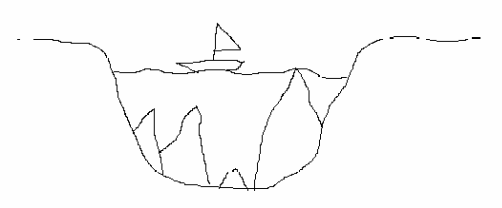
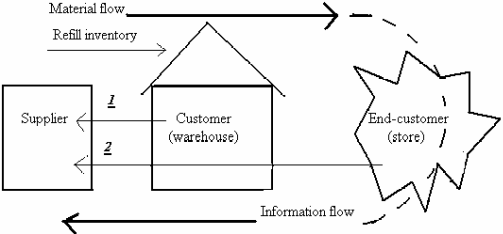
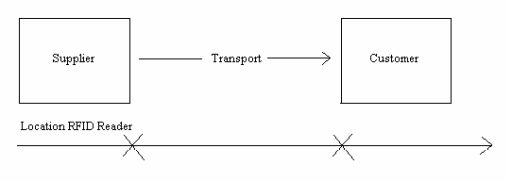
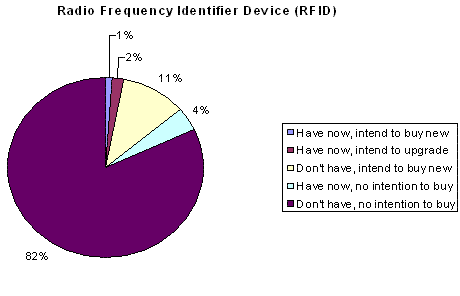
4.1 Internal Supply Chain ManagementThe progress in RFID technology has generated a change of direction for business opinion and interest. Better tracking and tracing ability, increased control of both assets and processes seem to be some of the benefits for almost every business (Bose & Pal 2005). The benefit from internal use of RFID is evident and the implementation is relatively easy according to Heinrich (2005).Because it is an internal approach, the applications are related to improving the internal supply chain. With RFID, the location of pallets and products in the warehouse can be tracked easily and orders can be planned more precisely. The shop floor in the manufacturing line can be mapped more thoroughly with a model that can be kept up to date. Similarly, RFID technology is being implemented in airports to track passengers as they move through the airport and thereby avoid costly delays to flights (Hibbert 2006). An important decision that suppliers and manufacturers need to make is the level of RFID implementation. Item-level tagging brings many more benefits, but because of tag costs, is suited to businesses that offer high-value items. 4.2 End to End SCMFrom huge research and development investments in RFID, Wal-Mart is the main investor in global RFID technology. Wal-Mart with its suppliers Gillette and Procter & Gamble have their RFID pilots still in the stage of investigation, but Wal-Mart is the leading company to expedite RFID development (McGinity, 2004). Heinrich (2005) states that “history is repeating itself” meaning that Wal-Mart had a similar effect on their suppliers and other industries when they wanted to use bar codes as a standard system years ago. Gillette and Proctor & Gamble have seen the advantages in their internal supply chains as well. For example, Gillette can trace or monitor all pallets of its feminine razors in one distribution centre. Gillette knows where every case of razors is in its packaging centre, how long the case has been there, where it is stored and when it will be shipped. This Wal-Mart mandate interests New Zealand food chains like Foodstuff as well. However, no actions are currently being implemented to bring RFID into New Zealand´s food chains but the RFID technology is observed offshore (iStart, 2004). 4.3 Inventory ManagementIn retail, AIDC is proven to be extremely useful in maintaining adequate stock levels for the distribution of goods such as those of food retailers (Heinrich, 2005). Maintaining an accurate inventory is critical to any operation. The ability to automatically record sales, check inventories, and replenish additional stock reduces the amount of inventory and waste in the system while helping to assure shoppers fresh new products on the shelves. Making accurate inventories also ensures that orders can be filled quickly and correctly with a minimum safety stock. One problem with inventory is the inefficiency of having high inventory levels. Inventory can mask potential problems in the business. This can be described by the “Japanese Lake” (Figure 1). In the Japanese lake the water level symbolises to the inventory level and the rocks at the bottom are hidden problems. If the seawater level is not lowered the business will not see the hidden problems that can cause inefficiencies. By lowering the inventory level (water level) the problems become obvious. By solving the problems, the business can become more efficient and streamline their processes. Streamlined business minimizes the inventory level and reduces unnecessary work (Liker, 204). For inventory management, RFID can “replace products with information” (Heinrich, 2005). For the customer packaged goods (CPG) industry, low inventory levels can be achieved through transparent information (Heinrich 2005). The transparent information allows actors access to the same information and can be used in several ways. That is, RFID provides real-time information about inventory levels and more detailed item level tracking that can allow smaller numbers of inventory to be kept on hand. In the CPG industry lower inventory levels can be achieved by using Vendor Management Inventory (VMI). Proctor & Gamble have a vision of a customer-driven supply network within a VMI arrangement. In this case the goods are pulled out from inventory, depending on actual demand rather than being pushed by inventory (Waller et al. 2001). The VMI arrangement is based on transparent information between the supplier and the customer. Currently, VMI uses two technologies; the EDI (Electronic Data Interchange) and the bar code system, UPC (Universal Product Code). In today’s VMI arrangement the information is based on centralised forecast and frequent connections to the inventory level. This approach reduces the problems of inventory. But the initial attempts for VMI have only seen a part of what would be possible when using RFID. The CPG industry can see a more thorough version of VMI with the RFID system. Rather than basing inventory levels and sales on forecasts, with RFID, the whole transaction process is changed for an optimised supply chain management based on up to the minute data. VMI is an integrated agreement where the supplier is responsible for the inventory even when the products have arrived at the customer’s warehouse. But, right now the VMI arrangement is one step away from the customer (Figure 4, 1) and has a broken chain of information about products from the supplier to the end customer, or at least to the store. This creates a time delay between stock checking and updating. But the unbroken chain can be a reality when using a fully integrated RFID system when the supplier can get information, not only from the nearest warehouse customer but also from the end-customer (Figure 2, 2). For RFID within VMI, the vision is to reach item-level tagging to create the so called customer driven supply network. Further, better service can be achieved by faster replenishment on the shelves and reducing checkout time. Instead of the checkout lane, the purchase could be confirmed when the RFID reader at the door registers the items and could even bill the customer’s credit card automatically. The supply chain could potentially be integrated better with an RFID system when data from objects are collected continuously. Imagine the supplier, loading finished products on a pallet. When the pallet is fully loaded it is delivered to the customer. If RFID readers were located at the exit of in the supplier’s warehouse and the entry of the customer’s, it could be possible to know where this pallet was without any confusion. The actors would know if the pallet was sent from the supplier line to the customer, or not (Figure 3). If, additionally, each item on the pallet is tagged, the warehouse would be able to do a quick check to see if the items received agree with the specification according to the Slap & Slip scenario. Wal-Mart are adopting “Slap and Slip”, letting goods pass through a static reader when they are received. This can be used with both pallet and item level tagging. The Slap and Slip application would also give better information about where the items are located in the supply chain. The Slap and Slip application could be a contributor in making information transparent between the supplier and the customer. If a bar code system was used, the inspector has to scan every bar code or if all the items are not visible the pallets have to reloaded, with RFID this process can be improved. The concept of delivering “the right product at the right time to its target” is a critical mission especially in distribution. The US Department of Defense (DoD) is an influential investor in RFID technology along with Wal-Mart, but mainly uses RFID in tracking the distributed assets for internal purposes. During “Operation Iraqi Freedom” the DoD used passive RFID tags to identify shipping units stored inside metal cargo containers that were themselves equipped with active RFID tags (Brown 2003). 4.4 ManufacturingManufacturing is considered a complex task with many products going through the process. It is important that the manufacturing process is undertaken correctly so the expected product quality is achieved. Bar codes, RFID, and vision systems have long been used in manufacturing to identify items, or batches of items, and ensure product quality. The identification systems have been used to track an item through work stations and record the tools that performed an operation on it. This information can then be used to quickly identify potential problems and correct them before they show up in the product. Early detection of faulty products in the process is supported by Toyta´s production philosophy, Toyota Production System (TPS) (Toyota 2006). TPS additionally encourages workers to halt production as soon as problems occur and to solve the problems straight away. This contributes to continuous improvements and increasing quality of the product being produced. One manufacturer that is actively using RFID technology is Club Car Inc, the maker of golf cars (Rothfeder 2004). This company has implemented RFID in their manufacturing process. An active tag is attached on every assembly carriage and at each stop on the assembly line, the carriage passes a reader that sends the cars identity data to a propietary manufacturing system. The software determines which custom options should be installed. Niche application areas for RFID involve cases where value can be added through the use of the technology such as in the golf car example above or the VMI example where less working capital can be tied up in stock on hand. RFID will also be most useful where the identification of individual product items (rather than product lines) can be used to the advantage of the business. This could be in terms of tracking stock shrinkage, item history or item location. 5. AUTO IDENTIFICATION TECHNOLOGIES IN NEW ZEALAND?During the last decade there have been attempts to develop effective models for New Zealand’s supply chains. The results have been varied, but all of them have been undermined by lack of standardised product and logistic data between trading partners (iStart, 2004). Now RFID is on its way to affecting logistical New Zealand business and according to a survey (iStart 2005 IT Investment Survey), around 10% of the participating managers had the intention of investing in RFID technology for the first time during 2005 (Figure 4). Most industry observers say it is only a question of “when” and not “if” the technology takes off. The biggest fears are related to the standards issue. Companies should also look at the price of the whole application rather than only calculate the cost per tag, because software and operations might have to be changed and adapted. According to David Wright (iStart, 2004), Systems Controls Limited has already completed five RFID projects and more are to come. Further, both Walker Datavision and, bar coding company, Saito said that their customers are talking about RFID pilots. According to representatives from the companies (iStart, 2004), equipment is already offered for use in a variety of warehousing, logistics and manufacturing applications; but as of writing, no project is completed. In New Zealand, RFID is set to have an important position with focus on the high-volume of export goods to the US, Europe, and Asia. Therefore, New Zealand businesses may be forced to take up RFID in order to continue international exports (82% don’t have and no intention to obtain). However, from the iStart survey, it is not clear whether respondents already have barcode technology and this would be an interesting topic for further investigation. 6. CONCLUSIONSThere are several areas where research on RFID technology is needed. Firstly, businesses should agree to one standard. The standard issue makes the RFID technology immature and complex which renders business unable to implement the technology. Together businesses can contribute to a sustainable and mature technology. Business can also use this technology between suppliers and customers. The EPC Network work is the standard for everyone to follow. Along with a standard agreement and decreased costs, broader business adoption would follow. Secondly more case studies are needed in RFID. Ideally, these would be cases where the contribution of RFID for the internal organisation is clear and profitable. To integrate the RFID throughout the supply chain is a big step to take at this early stage. First, companies must achieve a superb internal supply chain before they extend the network to their suppliers or customers. Therefore, further research could extend the internal unbroken supply chain to begin to investigate the totally integrated customer supply network. Thirdly, much of the current RFID development in supply chains has been in using RFID as they would a barcode. An interesting research direction would be to investigate RFID implementation in supply chains where the object is difficult or impossible to scan manually. For example, animal tags, pallets of goods or a tray of sterile equipment. Or perhaps where the environment prohibits the use of barcodes such as dangerous factory environments where fumes are present or toll or transit gates. REFERENCESAlbrecht, K. & McIntyre, L. (2005) Spychips. Nashville: Nelson Current. Brown, S. (2003) “The Defense Logistics Agency contributes to Operation Iraqi Freedom - Inside logistics: exploring the heart of logistics” Airforce Journal of Logistics, Fall, retrieved from http://www.findarticles.com/p/articles/mi_m0IBO/is_3_27/ai_111852899/pg_5 Bose I., & Pal, R. (2005) “Auto-ID: Managing Anything, Anywhere, Anytime in the Supply Chain”, Communications of the ACM, 48 (8), pp 100-106. BusinessWeek, (2004) “A Vast Web of Tiny Sensors”, Retrieved on January 10, 2006 from http://www.businessweek.com/ bwdaily/dnflash/sep2004/nf2004081_1700_db_81.htm Campbell, S. (2004) “Tracking lean”, Manufacturing Engineer, 83 (1), pp 38 - 41. Christopher, M. (2005) Logistics and Supply Chain Management, London: Prentice Hall. Fischer C.S. (1988) “'Touch Someone': The Telephone Industry Discovers Sociability”, Technology and Culture, 29(1), pp32-61. Fichman R.G. (1992) “Information Technnology Diffusion: A review of empirical research”, published in the Proceedings of the International Conference on Information Systems, Society for Information Management. Garfinkel, S., & Rosenberg, B. (2005) RFID Applications, Security, and Privacy, New York: Addison-Wesley. Gunther, O., & Spiekermann S. (2005) “ RFID and the Perception of Control: The Consumer’s View”, Communications of the ACM, Volume 48 (9), pp73-76. Heinrich, C. (2005) RFID and Beyond, Indianapolis: Wiley. Hibbert L. (2006) “Every Step You Take”, Professional Engineering, 19(5), pp22-23. Hoc, L., Moh, M., Walker, Z., Hamada, T., & Su, C-F. (2005) Applications: A prototype on RFID and sensor networks for elder healthcare: progress report. Proceeding of the 2005 ACM SIGCOMM workshop on Experimental approaches to wireless network design and analysis, Philadelphia, Pennsylvania, USA pp. 70-75. iStart (2004) “Technology in Business: NZ’s ICT Research Hub”, Retrieved on January 23, 2006 from www.istart.co.nz. Liker, J. (2004) The Toyota Way, New York : McGraw-Hill. Lucket, D. (2004) “Supply Chain”, BT Technology Journal, 22 (3), pp 50-55. McGinity, M. (2004) “RFID: Is this Game of Tag Fair Play?”, Communications of the ACM, 47 (1), pp 15-18. Molnar, D., Soppera, A., & Wagner, D. (2005) “Privacy For RFID Through Trusted Computing” Proceedings of the 2005 ACM workshop on Privacy in the electronic society, Alexandria, VA, USA,pp 31-34. Piasecki, D. (2005) “The Basics, The Wal-Mart Mandate, EPC, Privacy Concerns, and More”, Retrieved on December 18, 2005 from http://www.inventoryops.com/RFIDupdate.htm Rothfeder J. (2004) “Go For It”, Insight, August 1 Retrieved on January 23, 2006 from http://www.cioinsight.com/article2/0,1540,1780931,00.asp Sarma, S. (2004) “Integrating RFID”, Queue, 2 (7), pp.50-57. Staake T., Thiesse F., Fleisch, E., (2005) “Extending the EPC Network - The Potential of RFID in Anti-Counterfeiting”, Proceedings of the 2005 ACM symposium on Applied computing Santa Fe, New Mexico, pp 1607-1612. Toyota (2006) Toyota Production System, Retrieved on June 30, 2006 from http://www.toyota.co.jp/en/vision/production_system/ . Waller M., Johnson E.M. Davis T. (2001) “Vendor-managed Inventory in the Retail Supply Chain” Retrieved on August 8, 2006 from http://www.edm1.com/vmi_retail_sc.pdf . Copyright © 2006 Peter Karlsson and Judith Symonds |
|||||||||||||||||||||||||||||||||||||||||||||||||||||||||||||||||||||||||||||||||||||||||
|
Home | Issue Index | About BACIT
Copyright © 2006 NACCQ. Krassie Petrova, Michael Verhaart, Andy Connor and Judith Symonds (Eds.). An Open Access Journal, DOAJ # 11764120 |
|||||||||||||||||||||||||||||||||||||||||||||||||||||||||||||||||||||||||||||||||||||||||