|
Bulletin of Applied Computing and Information Technology |
Refereed Article A5:ICT in rural New Zealand: A review of the literature |
|
06:01 |
|||||||||||||||||||||||||||||||||||||||||||||||||||||||||||||||||||||||||||||||||
Fouad K. Shiblaq Shiblaq, F. K. (2008). ICT in rural New Zealand: A review of the literature. Bulletin of Applied Computing and Information Technology, 6(1). Retrieved March 14, 2012 from http://www.naccq.ac.nz/bacit/0601/2008Shiblaq_Rural_ICT.htm AbstractMany scholars argue that the term digital divide should include social and economic as well as technological factors. There are four cultural factors affecting ICT provision in rural New Zealand: political, economic, social and technological. These four factors (extracted from the literature) are used to critically discuss the impact of ICT provision in rural New Zealand, with a focus on the three main stakeholders: the New Zealand Government, the Internet Service Providers (ISPs), and the residents in rural areas. It was revealed by the study of the literature that the monopoly of telecommunications infrastructure by one company, high costs, and the residents' lack of knowledge of satellite broadband availability in rural areas, have contributed to the retarded broadband uptake in rural areas. KeywordsBroadband uptake, rural areas in New Zealand, ICT, digital divide, community informatics 1. INTRODUCTIONThe challenge for any country with a large rural sector in comparison with its low population is to provide ICT facilities in both urban and rural areas. Or else it is widening the digital divide between urban and rural areas, as urban areas enjoy broadband Internet, rural areas lack similar telecommunications infrastructure. Head (2004) mentioned that “The disparate distribution of the population and large proportion of rugged mountainous terrain pose particular challenges to establishing equitable access to a competitive telecommunications infrastructure” (Head, 2004, p. 1). Statistics New Zealand (2004) reported that New Zealand is recognized as highly urbanized with 86 percent of its population living in urban areas, compared with Australia with 85 percent, the UK with 90 percent, Europe with 75 percent, and the US with 77 percent Statistics New Zealand (StatNZ, 2004). However Weiser (1996) commented on how the Internet evolved in the past thirty years, “The internet has evolved from a military and defense system in the 1960s to a communications tool for research and education in the 1970s and 1980s, to a largely commercial enterprise in the 1990s” (Weiser, 1996, p. 1). The Internet has continued to evolve as an interactive medium empowering the user to participate in mass media as the case in blogs, e-government, and e-commerce. This paper will help explain:
Next the literature discuss the ICT issues and their impacts in rural 2. MAJOR ICT ISSUES AND THEIR IMPACTSeveral issues associated with ICT provision in rural NZ relate to political, economic, social, and technological factors. Because theses factors are considered fundamentally important to society’s prosperity, the challenges involved solving some of these issues make ICT provision in rural areas a national crisis. “Access is only a part of this picture. It is also about content, education and other tools for "cultural maintenance". Addressing the digital divide has to include that 57% who don't see a place for themselves online” (Butt, 2002, p. 3). 2.1 Political IssuesIn 2007 the Prime Minister Helen Clark was not pleased with the state of telecommunications in New Zealand, blaming Telecom and its rivals for the degraded ICT provision in New Zealand, and its low standard compared with other countries in the Organisation for Economic Co-operation and Development (OECD) (Keown, 2007). Prior to 2001 Telecommunications Act, the telecommunications industry was an open economic competition with the least amount of regulation. The Act stated the necessity for identifying an authority to regulate and endorse competition in the telecommunications market, and address the latest technological advancements provision for users in urban and rural areas alike (Head, 2004). The debate is to upgrade (TI) in rural areas, in the meantime, competition among main ISPs in New Zealand has intensified on issues such as broadband provision, “Local Loop Unbundling”, and the “Kiwi Share Obligation”, which now known as the “Telecommunications Policy Obligations” (TPO). The birth of a new Telecommunication Amendment Bill before the end of 2007 was imminent, but it did not emerge. The tricky point was the dispute between Telecom and the The Parliament’s finance and expenditure-selected committee recommended that Telecom should split into three units: network access, wholesale, and retail. However, Telecom agreed to a two-way split retail and wholesale (excluding network access) (Keown, 2006). On the other hand Williamson (2006) explained how the ranking of “We all need to work together to drive urgent, ubiquitous uptake, while at the same time developing innovative uses that will deliver a step change for farm productivity and rural lifestyles. There is a huge opportunity at the door of our farming and IT sectors to lead the world in rural technologies based on connected farms” (Newman, 2006, p. 2). The InternetNZ (2006) described the telecommunication environment in New Zealand as a single company that practices Significant Market Power (SMP) preventing any rivalry repressing investment chances (InternetNZ, 2006). Nikiel (2006) stated recently the following on Telecom split: “The ACNielsen poll announced voters strongly supported Telco regulation. The poll showed 71 per cent of voters supported the Government’s May proposal to give power to the Commerce Commission and for Telecom to open its fixed line network to competitors. 69 per cent supported Telecom’s split into retail, wholesale and network access unit, and 63 per cent supported laws for new mobile entrants “ (Nikiel, 2006, p. 1). Darian Bird, an analyst at IDC, was skeptical that the unbundling of the local loop would benefit customers in rural areas: “There’s a risk that when the local loop is unbundled, less profitable rural customers will miss out on any service improvements. The Telecommunication Service obligation (TSO) needs to be reviewed to prevent the technology gap widening between town and country” (Keown, 2007a, p. 2). By the time this article was published, Telecom has not yet come up with a split plan that would satisfy the government’s recommendations. Although urban areas such as Auckland is witnessing an increase in broadband users, whom recently outnumbered dialup users, but rural areas’ users still have inadequate telecommunications infrastructure in their areas and slow broadband uptake. 2.2 Economic IssuesTelecommunications competition focused on wealthier regions and Central Business Districts. This has contributed to the withdrawal of banks, government departments, post offices, and businesses from provinces. Newman (2003) stated that at the start of the communication revolution hopes were high that small businesses would flourish; regional and rural development would thrive and minimize migration to major cities. “Despite being the first nation in the world to fully deregulate telecommunication our carriers squandered their global edge squabbling with each other over who had rights to what, more interested in pleasing shareholders than closing the digital divide” (Newman, 2003, p. 2). Cost and ROI are two important issues for ICT provision in rural areas; Archer (2004) specified cost as one of the factors behind the “digital divide” phenomena. A household with an income of $100,000 is likely to have Internet connection more than four times than a household with $15,000 income (Archer, 2004). Birss (2003) cited Bruce Parkes, Public Affairs Manager at Telecom, who said: “ Charges are an economic issue to help Telecom recover the cost of regional carriage of telephone calls, under Telecom Kiwi Share arrangement with the State” (Birss, 2003, p. 105). Cited in StatNZ (2004), Table 1 shows the annual personal income for different urban and rural areas. Table 1. Annual Personal Income for Urban and Rural Profile Areas (Source: StatNZ, 2004, p. 77)
Telecom claim that the cost by using existing technologies to upgrade its network, is $230 million to provide more than 95 percent of customers with 14.4k Internet speed; and it costs $550 million to provide all customers with 33k Internet speed (Anderson, 2000). To support Mr. Anderson’s report, Kane (2003) drew the attention to the benefits of implementing a development strategy in promoting rural and small urban areas:
Six main opportunities that arise from using broadband in rural areas are: automated recording of valuable data; data sharing; specialized support and servicing; security; communications; and new ways of doing business (Adams, 2003). The above-mentioned opportunities will eventually benefit rural areas’ residents and make them aware of ICT provision advantages in their area. The increase in profit and the opening of new markets will give farmers the ability to seek knowledge to learn more and spend generously in order to become active online. One example is the website www.fencepost.com, powered by Fonterra Dairy Farmers for farmers throughout “At present New Zealand is approximately three years behind the broadband performance required to meet the Digital Strategy target and has four years to catch up” Cabinet Policy Committee (POL, 2006, p. 10). 2.3 Social IssuesBirss (2003) and Stoke, Aitken, & Kerr (2001) identified the risk due to lack of ICT provision in the rural sector, and noted that farmers and residents could be at risk in rural areas in the midst of this new evolution. However others noted the opportunities and the challenges awaiting the residents in rural areas. “E-commerce is a new method of transacting business using information technology, which allows physical processes to be replaced by electronic ones” (Stoke, Aitken, & Kerr, 2001, p. 16). The first challenge is to enlighten the resident of rural areas of the opportunities and change that the Internet can make. “The first step in lifting rural telecommunications should be to make country people aware what the Internet can do for their businesses and for their families” (Birss, 2003, p. 103). Stoke, Aitken, and Kerr (2001) described how ICT provision offered
“The rural sector produces more than 60% of export earnings, and about 50% of employment in manufacturing is downstream of the rural sector” (Stoke et al., 2001). The second challenge is to include all sectors of society. The demographic profile of ICT inclusion in In addition, developed countries as well as poor and developing countries can be disadvantaged from these circumstances. “These groups include Maori, Pacific peoples, those on low incomes, sole parents, older people, people with no or low qualifications or poor literacy, the unemployed, people with disabilities and people living in rural areas that lack a sound telecommunications structure” (Crump & McIlroy, 2003, p. 13). Hutchinson, Owens, Howard, & Smith (2000) have confirmed that the disadvantaged sections in “ Maori and Pacific Island Peoples, those with lower incomes, sole parents, people with low or no qualifications, those who are unemployed or underemployed, and those in locations without a sound telecommunications structure, such as parts of rural New Zealand” (Hutchinson, Owens, Howard, & Smith, 2000, p. 3). Education is usually related to social and economic issues, therefore the cooperation or partnership between schools, businesses, and government has developed projects aiming at improving students and community educational attainment overcoming hurdles of physical access, ability, attitude, and including all stakeholders (Boyd, 2002). The education sector scored 63.2 per cent for net readiness in New Zealand behind business services (Clark, 2001). The advantages of broadband over dialups reported by Gardiner (2006), such as increasing the quality and the inclusion of more artwork files due to the larger bandwidth; distance learning “The 512 Kbit/s symmetric deliverable of Provincial Broadband Extension(Project Probe) is for schools to be able to videoconference” (Gardiner, 2006, p. 1). He also added “For many smaller, rural schools in New Zealand, the challenge of providing a sufficiently broad range of curriculum options for students at the senior level of school can't be met within the local learning environment” (Gardiner, 2006, p. 5). Table 2 shows Internet access according to type, on age, ethnicity, and gender. Table 2. Internet Access by Age, Ethnicity, and Gender (Source: Maharey & Swain, 2000, p. 9)
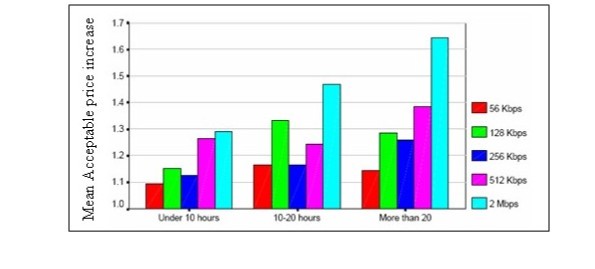
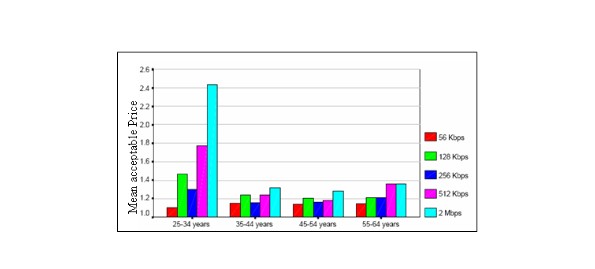
Figures 1 and 2 showed that Internet user between the age of 25-34 and who spends more than 20hours monthly is willing to pay more for a better internet service in the Otago and Southland areas. Figure 1. Farmers' Acceptance of Price Increase: “Level of Use” in Otago and Southland (Source: McNeill & Canny, 2001, p. 20 ) Figure 2. Farmers' Acceptance of Price Increase: Montly Use “By Age” in Otago and Southland (Source: McNeill & Canny, 2001, p. 20) Nanthikesan (2000) wondered whether the divide between urban and rural areas in countries with high income is the same as countries with low incomes. In the outcome of comparative case studies conducted in 2.4 Technological IssuesInfrastructure provision in rural areas forms a concern from a technical point of view, for instance, asymmetric Digital Subscriber Line (ADSL) or broadband has a speed of 512 Kbps-2.5 Mbps in urban areas, whereas most rural areas are limited to 28 Kbps-56 Kbps in some areas using dialups. Birss (2003) describes in his book, how rural residents suffer on a daily basis from low speed Internet. “The Brittain family farm is 22 km from town. Tim, on standard dial-up modem, normally accesses the Net at 28 Kbps, but often the speed drops to around 9 Kbps” (Birss, 2003, p. 110). Broadband has throughput of up to two Mbps used for different types of applications such as multimedia, whereas dialup technology uses the old technology Public Switched Telephone Network (PSTN) landlines to transfer data. It is important to remember that PSTN was originally designed for voice communications, not to transfer data, therefore extra support from backbone networks is needed for broadband access, Amos Aked Swift (NZ) Limited (A.A.S., 2001). Information Technology Policy Group of Ministry of Economic Development, ITPG (2000) gives technical explanations to improve the quality of data transferred. “Bandwidth is usually measuring the number of bits of information per second that can be transferred” (ITPG, 2000, p. 1), consequently low bandwidth or low speed is any link below (100 Kbps) and high bandwidth links are in the range of 100 K to 2 Mbps (ITPG, 2000). AAS (2001) reported that by increasing and distributing the number of Public Switched Telephone Network is the first step to improve telecommunications infrastructure. “The distribution and numbers of PSTN switches and transmission nodes are the starting point to develop broadband data services” (A.A.S., 2001, p. 9). New Zealand statistics in 2004 show the percentage of Internet access in highly rural/remote areas, satellite urban communities, and independent urban communities were 30.7 percent, 28.4% and 25.9 % respectively, lower when compared with 37.4 percent of whole of New Zealand (StatNZ, 2004). The survey results showed that rural areas residents were as enthusiastic as their counterparts in urban areas to access the Internet and be part of the online era, but due to the present state of dialup connection, a lot of them are discouraged to go online. A survey conducted by Atkins (2000) showed that fifty eight percent of rural residents reported problems with their telephone lines, while fifty two percent of businesses were not satisfied with the service they were getting. Table 3 show issues associated with telephone lines in rural Table 3. Residents'’ Issues Associated with Telephone Lines in Rural New Zealand (Source: Atkins, 2000, p. 42)
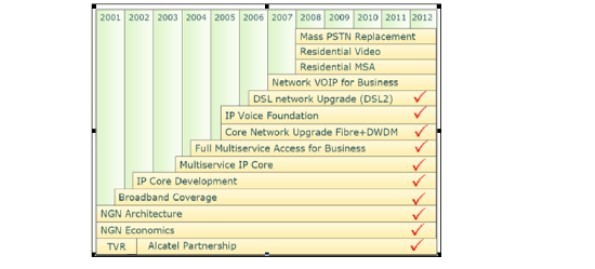
When iPSTAR, the world’s largest communication satellite, with “three spot beams” was launched in 2005, a lot of people thought that this could put an end to the digital divide issue. Brislen (2005) suspected that rural areas would surpass urban areas starting a new “digital divide” due to the launch of iPSTAR in 2005, covering the whole of But keep in mind that satellites have a limited operational lifetime, iPSTAR for example, which was launched in 2005 is expected to operate for 12 years only. Burley (2006) stated that the broadband uptake limitations experienced by wire lines today’s, wireless and microwave technologies can offer an alternative deployment for rural areas. According to him fixed-to-Mobile Substitution (FMS) is the technology to replace copper, by using Wireless Local Loop (WLL) in rural areas (Burley, 2006). Herman (2006) described how new broadband technologies can replace the copper wire. The technologies that were exhibited in the TUANZ Rural Broadband Symposium in Timaru March 2006 were Telular Phonecell. Telular Phonecell can run a fax machine, a phone, and a computer it uses Telecom’s CDMA network to access the Internet at Telecom’s mobile data card rate. However, the wireless broadband WiMAX microwave access, which covers greater distance, has faster speed, and is cheaper to install. Therefore, this makes WiMAX suitable to rural communities. This technology is considered a turning point for extending broadband coverage outside urban areas. “WiMAX uses the same technology to provide access (the user’s link to the base station) and backhaul (the link from the base station back to the Internet gateway), thereby reducing the cost of infrastructure roll-out by removing equipment and maintenance costs” (Herman, 2006, p. 4). According to Figure 3, which shows Telecom’s New Generation Network time line, was released on March 2006 (Network-Strategies, 2006a), this shows that the coming four years will witness a massive change in telecommunications infrastructure. Figure 3. Telecom’s NGN Time Line as of March 2001 3. GOVERNMENT CONTRIBUTIONThe New Zealand Government identified the challenges aligned with the issues that exist due to the “digital divide” between rural and urban areas. The government was firm on turning this “digital divide” into a “digital opportunity”. These were:
There were some empirical studies formed to find the degree or the size of the “digital divide” in rural areas in
4. CONCLUSIONThere are more dimensions than technology to the term ‘digital divide’, such as social and economic factors. It is not only the responsibility of the government to stand alone against the slow broadband uptake, but part of this responsibility falls on the ISPs and other private organisations to provide accessible deals and think less on how to generate profits for shareholders. There is a huge opportunity for the IT sector and farming to lead the world once again in rural technologies based on connecting farms. These opportunities are awaiting rural areas and farmers when they incorporate broadband Internet in their daily routines. The literature also mentioned a number of recommendation the establishing of Telecenters is one of them, and formulating IT teams by the New Zealand government in example MED to organise visits to highly remote rural areas and arrange for education programmes for its residents, such as various options that they have available in their areas to have broadband for example satellite broadband. This does not suggest that the problem is the people in rural areas; on the contrary it is stakeholders’ responsibility, residents, ISPs, and government. 5. ACKNOWLEDGEMENTThe author would like to acknowledge Caroline Malthus's work, on the proofreading and the final appearance of this report to meet publishing standards. REFERENCESA.A.S. (2001). Review of telecommunications infrastructure to small towns. Retrieved April, 20, 2006, from http://www.med.govt.nz/upload/19019/ruralccess.pdf Adams, G. (2003). Rural and primary industry: A renaissance in our heartland. In G. Adams (Ed.), Survival of the fastest (pp. 53-64). Auckland: TUANZ. Retrieved April, 25, 2006 from https://www.tuanz.org.nz/library/4a27fc45-48ff-4b8c-83d0f2125880464b.cmr#search=%22George%20Benwell%20%2B%20Digital%20divide%20%2B%20ICT%20in%20rural%20New%20Zealand%22. Anderson, A. (2000). Ministerial inquiry into telecommunications: Report on issues raised in submissions. Wellington. Retrieved April, 19, 2006 from http://www.teleinquiry.govt.nz/reports/draft/arthur.pdf. Archer, D. (2004). The digital divide 2004. Wellington. Retrieved September, 15, 2006 from http://www2.stats.govt.nz/domino/external/pasfull/pasfull.nsf/ Atkins, T. (2000). Telecommunications: Use, constraints and potentials in rural areas (No. 0478-20088-9). Wellington: Hortvision Ltd, Ministry of Agriculture and Forestry. Retrieved May, 2, 2006 from http://www.maf.govt.nz/mafnet/rural-nz/people-and-their-issues/communication/telecommunications-use-and-constraints/teleconst.htm. Birss, N. (2003). Farming and horticulture: Growing broadband. In G. Adams (Ed.), Survival of the fastest (pp. 101-110). Auckland: Telecommunications Users Association of New Zealand (ITUANZ) Inc. Retrieved July, 3, 2006 from: https://www.tuanz.org.nz/library/4a27fc45-48ff-4b8c-83d0-f2125880464b.cmr#search=%22George%20Benwell%20%2B%20Digital%20divide%20%2B%20ICT%20in%20rural%20New%20Zealand%22. Boyd, S. (2002). Literature review for the evaluation of the digital opportunities projects. Wellington: New Zealand Council for Educational Research. Retrieved June, 12, 2006, from http://www.educationcounts.edcentre.govt.nz/publications/schooling/literature-review.html Brislen, P. (2005). Satellite broadband blasts off in New Zealand. Computer World, 1-3. Retrieved January, 13, 2007 from http://computerworld.co.nz/news.nsf/rss/30724166B30724169C30724141A30724148CC25706500104289 Burley, N. (2006). Broadband overview: Asia-pacific. London: Ovum. Retrieved January, 12, 2007 from http://store.ovum.com/Product.asp?tnpid=0&tnid=65272&pid=38472&cid=0 Butt, D. (2002). Slow connections - building-non urban infrastructure online. (Report). Wellington: The Waikato Polytechnic. Retrieved July, 3, 2006 from www.icvp.com Clark, D. N. (2001). Net readiness in New Zealand industries: Empirical results, 2001. Hamilton: Waikato Management School. Retrieved September, 10, 2006 from http://www.med.govt.nz/templates/MultipageDocumentTOC____16387.aspx. Crump, B., & McIlroy, A. (2003). The digital divide: Why the "don't-want-tos" won't compute: Lessons from a New Zealand ICT project. First Monday, 8 (12), 1-20. Retrieved December, 24, 2006, from http://firstmonday.org/issues/issue2008_2012/crump/index.html. Gardiner, C. (2006). Schools pioneering broadband road. Retrieved November, 5, 2006, from http://m-net.net.nz/networking/features/schools-pioneering-broadband-road.php Head, M. (2004). Addressing the ‘digital divide’ in Aotearoa New Zealand. Retrieved September, 3, 2006, from http://www.community.net.nz/HotTopics/Digital-Strategy/Background/addressing-digital-divide.htm Herman, M. (2006). Down on the farm and up with the play. TUANZ, 1-6. Retrieved January, 6, 2007 from https://www.tuanz.org.nz/library/cd2080d2256-7598-2004e2004f-8139-f77004acbc77029.cmr Howell, B. (2001). The rural-urban "digital divide" in New Zealand: Fact or fable? Journal, 19(3), 231-251. Retrieved from http://www.iscr.org.nz/documents/ruralurban_digital_divide.pdf Hutchinson, V., Owens, D., Howard, J., & Smith, R. (2000). The digital divide. [Electronic]. The Jobs Letter(131), 1-10. Retrieved September, 22, 2006 from http://www.jobsletter.org.nz/jbl13100.htm InternetNZ. (2006). Advancing telecommunication services for New Zealand in the 21 century. Retrieved November, 9, 2006, from http://www.internetnz.net.nz/pubs/submissions/2006/2006-02-22-stocktake-submission/view?searchterm=rural%20broadband ITPG. (2000). Technology aspects of the digital divide. Retrieved October, 29, 2006, from http://www.executive.govt.nz/minister/maharey/divide/divide3.pdf ITU. (2006). ICTs go rural. Retrieved November, 5, 2006, from http://www.itu.int/osg/spu/wsis-themes/ict_stories/themes/e-rural.html Kane, T. (2003). Central Waikato economic development strategy (Report No. ED Strategy Final Release.rtf). Hamilton: New Zealand Trade & Enterprise. Retrieved November, 23, 2006 from http://www.nzte.govt.nz/common/files/waikato-strategy.pdf. Keown, J. (2006). Telecom: Split could cost us $115m a year. The New Zealand Herald, pp. 7-8. Retrieved January, 3, 2007, from http://www.nzherald.co.nz/author/story.cfm?a_id=2312&objectid=10413104, from http://www.nzherald.co.nz/author/story.cfm?a_id=312&objectid=10413104 Keown, J. (2007). Telecom may face rural liability. The New Zealand Herald, pp. 4-5. Retrieved January, 28, 2007 from http://www.nzherald.co.nz/author/story.cfm?a_id=2312&objectid=10419453, from http://www.nzherald.co.nz/author/story.cfm?a_id=312&objectid=10419453 L.M.P.G. (2001). Closing the digital divide - summary of stakeholder discussions. Retrieved September, 15, 2006, from http://unpan1.un.org/intradoc/groups/public/documents/APCITY/UNPAN005825.pdf Maharey, S., & Swain, P. (2000). Closing the digital divide- what do we know about the digital divide in New Zealand? Retrieved October, 29, 2006, from http://www.executive.govt.nz/minister/maharey/divide/divide1.pdf McNeill, R., & Canny, S. (2001). Blazing a trail to the information highway (Report No. dc/01/9/7806). Otago: Otago Southland High Speed and Broadband Communications Committee. Retrieved September, 13, 2006 from http://www.nzte.govt.nz/section/13609/11040.aspx. MED. (1999). The social impact of information technology. Retrieved April, 6, 2006, from http://www.med.govt.nz/templates/MultipageDocumentTOC____16813.aspx Nanthikesan, S. (2000, November). Trends in digital divide. Retrieved April, 10, 2006, from hdr.undp.org/docs/publications/background_papers/nanthikesan.doc Network-Strategies. (2006a). Telecommunications industry investment in New Zealand (Report No. 25045): MED. Retrieved March, 5, 2007 from http://www.med.govt.nz/upload/36789/industry-investment.pdf Newman, E. (2006). Farming online - a huge IT opportunity. Retrieved November, 5, 2006, from http://m-net.net.nz/articles/tuanz/farming-online-a-huge-it-opportunity.php Newman, K. (2003). Regions on wrong side of digital divide. Telecommunications Review(03), 1-4. Retrieved March, 7, 2007 from http://www.wordworx.co.nz/TelecomsReviewRuralBBand.htm Nikiel, C. (2006). Regulation ok for others but not for others. The New Zealand Herald, 1-3. Retrieved January, 7, 2007 from http://www.nzherald.co.nz/author/story.cfm?a_id=2292&objectid=10414745. POL. (2006). Minute of decision. In D. Cunliffe (Ed.) (Vol. 2007, pp. 1-60 Personal communication). Wellington: Beehive. Retrieved November, 5, 2006 from http://www.beehive.govt.nz/Documents/Files/Cabinet%20paper%20and%20minute.pdf. StatNZ. (2004). New Zealand: An urban/rural profile. (Report). Auckland. Retrieved May, 3, 2006 from http://www.stats.govt.nz/NR/rdonlyres/A2FDF8E9-32AD-487D-AEE7-040F513EE777/0/NZUrbanRuralProfile2.pdf Stoke, M., Aitken, A., & Kerr, J. (2001). The implications of e-commerce for the primary sector (Technical Paper No. 01/4). Auckland: Martech Consulting Group Limited-prepared for MAF. Retrieved October, 5, 2006 from http://www.martech.co.nz Weiser, L. (1996). Economic and business information on the internet. Retrieved June 10, 2007, from http://www.uwsp.edu/business/cwerb/3rdQtr96/SpecialReportQtr3_96.htm Williamson, A. (2006b). Comparison of OECD broadband markets (Report). Auckland: Wairua Consulting Limited, New Zealand Tourism Research Institute, and AUT University. Retrieved March, 15, 2007, from:www.wairua.com. Home | Issue Index | About BACIT
| |||||||||||||||||||||||||||||||||||||||||||||||||||||||||||||||||||||||||||||||||||