Mobile Commerce Implementation in the Hospital Environment: Issues, Challenges and Future Trends
Bulletin of Applied Computing and Information Technology Vol
2, Issue 1 (March 2004). ISSN 1176-4120.
Rachel Evans
Nurul Sarkar
Auckland University of Technology,
New Zealand
nsarkar@aut.ac.nz
ABSTRACT
The rapid growth in mobile and wireless technologies in recent years has given rise to a strong interest in implementing mobile commerce (m-commerce) in the hospital environment. Many hospitals across the globe have already been implemented some aspects of m-commerce, including wireless networking infrastructure, clinical and administrative applications. However, the complexity of healthcare delivery makes it a challenging task for the full deployment of m-commerce in the hospital environment. This paper addresses some of the issues and challenges for large-scale implementation of m-commerce in the hospital environment. The underlying drivers for the uptake of m-commerce in healthcare are examined, and the wireless networking infrastructure for a large-scale implementation of m-commerce is presented. The paper concludes by discussing future trends of m-commerce in the healthcare setting.
Keywords
Mobile commerce, hospital environment, wireless networking infrastructure, large-scale implementation
1. INTRODUCTION
The benefits of m-commerce in healthcare, and specifically hospitals, can indeed be very compelling. When judiciously and carefully implemented in the areas of most need and anticipated return, m-commerce has the potential to significantly improve not just operating efficiencies, but the quality of patient care and to literally save lives.
Many hospitals have invested significantly in Information technology (IT), including clinical and administrative applications, and networking, to support their services (Cox, 2003). Hospitals have some history with mobile technologies as were the first significant institutional adopters of pagers, and many doctors have enthusiastically embraced mobile telephones and personal digital assistants (PDAs) for their personal use (Vink, 2002; Hau, 2001). Due to this history and the nature of healthcare delivery, the hospital environment appears well suited to the adoption of m-commerce. Wireless technology makes productivity sense whenever workers are mobile and work with time-critical data. Hospitals are considered early adopters of wireless technologies (Gruman, 2003). However, the complexity of healthcare delivery makes it a challenging task for the full deployment of m-commerce in health care settings. This complexity is evidenced in multidisciplinary professional personnel, sophisticated clinical information needs, complex organizational systems, tight regulatory frameworks and fiscal constraints. Kenedy (2003) mentioned that about 10-20% of USA hospitals are using IEEE 802.11b (Wi-Fi) wireless networks, and Coonan (2002) pointed out that the uptake of m-commerce has been greater in large metropolitan hospitals than smaller hospitals.
The remainder of this paper is organised as follows. Section 2 examines the drivers for the uptake of m-commerce in the hospital environment. The wireless networking infrastructure for a large-scale implementation of m-commerce in healthcare is presented in section 3. Some of the issues and challenges for the large-scale implementation are discussed in section 4. Future trends are highlighted in section 5, and section 6 concludes the paper.
2. DRIVERS FOR M-COMMERCE IN HOSPITALS
A major driver is error reduction and improved quality of care. In 1999, the US Institute of Medicine published a report estimating that every year 770,000 adverse drug events lead to injury or death in US hospitals (Kenedy, 2003). M-commerce is helping to address this through medication safety applications. At one US children’s hospital, nurses dispensing drugs use a handheld device to scan a barcode on their ID badge, a barcode on the patient’s wristband, then a barcode on the drugs. This data is transmitted via a wireless local area network (WLAN) to a central server. The application is designed to check for errors such as wrong drug, wrong time of day, wrong dosage, or potential interaction between drugs.
Another driver is e-prescribing systems. A prescription is created electronically on a handheld device. Whilst inputting the order, the doctor can be prompted about the hospital or insurer’s drug formulary, plus any potential drug interactions. The prescription is then transferred over a WLAN to the hospital pharmacy, or via a virtual private network (VPN) to a community pharmacy. The error reduction in avoiding illegible handwriting problems is of such value that some malpractice insurers offer premium discounts for doctors who use e-prescribing systems (Coonan, 2002).
Electronic patient medical records have long been recognised as important to improving the quality of care, by enabling fast comprehensive access to real-time information. Many m-commerce examples focus on accessing the e-medical record. There is some debate in the literature as to whether mobile devices should be considered as an adjunct only for accessing a subset of the record, or whether they can be used to access the full record (Porn & Patrick, 2002). However such debates may become moot as m-commerce technology advances.
Some hospitals are also utilising wireless monitoring or telemetry, with devices such as electronic stethoscopes, pulse oximeters or infusion pumps. Another utility is the wireless tracking of equipment and people within the hospital space. Other drivers within the ‘error reduction and improved quality of care’ category include more demanding clinical documentation regulations (partially driven by litigation), utilisation of clinical decision support tools, such as patient care pathways and guidelines, and the expectations of patients used to utilising m-commerce in other personal and business environments. One example of m-commerce for efficiency is the wireless bedside registration of new patients via the wireless connection, admitting clerks come to the bed. This includes scanning patient’s insurance cards and driver’s licences, as well as inputting medical and demographic data (Anonymous, 2003).
Another efficiency area is using m-commerce for ordering and accessing diagnostic tests. As well as being able to order tests from the point of care, orders placed can be matched against tests already performed to remove duplication. Results can then be immediately forwarded to the handheld of the ordering doctor, a potentially life-saving time improvement. Carpenter (2002) describes a m-commerce system for accessing radiology results which has saved an estimated 7,000 doctor hours a year otherwise spent in tracking down films, with a $1.2M annual saving in personnel and film costs. Providing electronic information at the doctor’s convenience improves workflow: “it really impresses people that any clinician can actually see an X-ray or a CT scan image on his PDA, while sitting in the cafeteria” (Cox, 2002).
The initial outlay involved in moving to m-commerce systems can be seen as a barrier to their adoption (Turisco, 2000; Scannell, 2002). However, it is argued elsewhere that the longer term running costs of wireless local area networks (WLANs), particularly in terms of reconfiguration to suit the changing needs of hospitals, and also implementing upgrades, can be cheaper than for fixed wired LANs (Owens et al, 2001).
In a user-pays hospital, m-commerce can assist with revenue generation through improving ‘charge capture’. This is the coding of clinical procedures undertaken, and all associated expenses, in order to bill the patient/health insurer. Porn & Patrick (2002) suggest that through their convenience at point of care, m-commerce charge capture can significantly reduce the amount of never-recorded charges.
3.
WIRELESS NETWORKING INFRASTRUCTURE FOR M-COMMERCE
Infrastructure based wireless networks use a wired LAN backbone and create an area of wireless connectivity through the use of access points. The speed of connectivity depends on the standard used, ranging from 11Mbps for IEEE 802.11b, to up to 54Mbps for the newest standard IEEE 802.11g/a. IEEE 802.11b seems to be the most common standard in hospital WLANs at present.
For many hospitals, a wireless infrastructure network is an obvious solution because they already have wired LANs, but want to extend their reach. Whilst this could be done with additional cabling and ports, to which portable devices could be plugged, WLANs avoid extra cables in an environment in which they can be a hazard, the disruption of cabling installation, and its fixed nature which makes layout reconfiguration difficult (Anonymous, 2002). In many examples, WLANs have been implemented in limited parts of the hospital, such as the emergency department, or the children's wards, where the business need and benefits are seen as the greatest. This dominant model suggests that wireless networking technology is being employed as adjunct to, not a replacement for, wired networks. For example, a US hospital installed about 60 wireless access points to enable coverage of their 900-bed facility (Cox, 2002). Figure 1 shows the wireless networking architecture of a typical hospital m-commerce application. The authentication server controls user access to wired backbone LAN resources. The wireless network analyzer is used to detect rogue access points clients and to monitor radio channel.
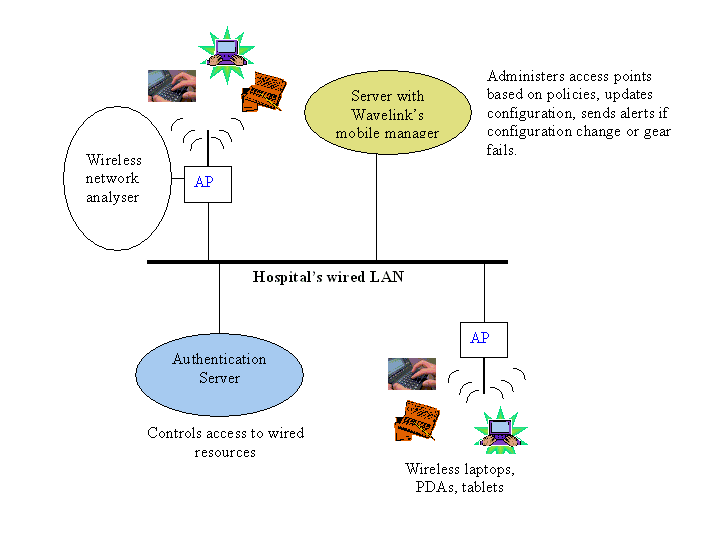
Figure 1. Wireless networking architecture of a typical hospital m-commerce application
An alternative to infrastructure based wireless networking is an ad-hoc network. These are entirely wireless LANs or WANs. No such examples were found in the literature, presumably due to hospitals extending on existing wired LANs, as already discussed. In terms of the common devices employed for hospital m-commerce, there is a full range, including WAP enabled mobile phones, PDAs, notebook, tablet and laptop PCs - often mounted on mobile carts that can be wheeled between patients or wards. Porn & Patrick (2002) note that current technology of handheld devices results in a tradeoff between mobility and depth of functionality.
Whilst many of the examples encountered have used vendor-built solutions to access legacy hospital applications through handheld devices, Hashem & Roggeri (2003) make a convincing argument for the importance of XML and web services as the ‘unifying power’ in exchanging data in an efficient way. They suggest this can be achieved through integration engines and orchestrators, such as Microsoft Biz Talk Server.
We can highlight several New Zealand hospital examples where some aspects of m-commerce have been implemnted. Taranaki based hospital is using notebook PCs through wireless connections on selected wards to access its web-based e-records system (Bell, 2000). The Dunedin hospital has implemented an IEEE 802.11b WLAN in specific areas to access e-medical records, including lab data and X-rays (Watson, 2002); this year a trial e-prescription system has been implemented in one ward and is to be extended (Watson, 2003). At Auckland’s new hospital, the emergency department and the short stay unit have been wireless enabled (Watson, 2003b). Middlemore hosptial in South Auckland has installed an IEEE 802.11b WLAN in the emergency department allowing bedside registration of patients using laptop computers (Greenwood, 2000).
4.
CHALLENGES OF IMPLEMENTING M-COMMERCE IN HOSPITALS
As an emerging technology, m-commerce certainly presents some implementation challenges for hospitals. The key ones can be categorized as human, technical and performance, and security. Coonan (2002) mentioned that “just a few years ago, physician and clinician acceptance was one of the primary factors working against utilization of point of care technology”, but that the obvious benefits of m-commerce have started to change this.
An interesting issue in m-commerce is evidence that the convenience of wireless technology offers quantifiably greater benefits than just ‘being computerized'. Whilst all the doctors thought that e-prescriptions would improve accuracy over hand-written ones, when this application was available through wired PCs, uptake was 40%; once the doctors had handheld computers, update nearly doubled. Porn & Patrick (2002) pointed out that “to gain acceptance by physicians, the mobile applications must be easy to use and perceived as improving the physician's workflow and revenue stream.” An m-commerce implementation needs to follow best practice as for any major IT implementation, and should involve key users at all stages, with testing, pilots, and carefully planning. Coonan (2002) highlights the benefits of department-by-department m-commerce installations, taking time to study and address problems along the way.
Some of the technical and performance challenges of implementing m-commerce in hospitals are:
- Integration of m-commerce applications with legacy information systems;
- Devices that can cope with minor liquid spills and occasional impact from dropping
- Adequate battery life of handheld devices
- Limited bandwidth of wireless networking may be an issue for multimedia content delivery
- Communications performance that varies with environmental conditions such as distance, user load and interference
- Finding vendor products that are reliable and meet user needs – particularly in terms of clear screens and graphical capabilities. Mobile devices should be ergonomically sound and adjustable
- Devices that can cope with minor liquid spills and occasional impact from dropping
Ensuring devices do not interfere with other electronic hospital equipment, such as heart monitors, and are not affected by other radio signals or microwave ovens. This requires WLANs to be managed in the context of the total wireless spectrum used by a range of hospital equipment, much of which uses the same 2.4GHz band as IEEE 802.11b.
As there are competing vendors for wireless systems, these need to be evaluated for factors such as reliability, ease of installation, ease of use, connection range, ease of upgrading, ease of network management, security, ongoing technical support, purchase and lease options. Hau (2001) suggests that mobile applications should be able to run on multiple device platforms in order to accommodate doctor-preference, flexibility and future proofing.
Cox (2003b) pointed out that the security issues regarding maintaining a WLAN require similar skills to those developed for a LAN, but there are some additional factors to consider, particularly around access points. Three key security aspects need consideration: secrecy, integrity and availability. All technical security measures would also need to be supported through appropriate policies and procedures. In terms of secrecy, standard tools to prevent unauthorised access to data are unique user IDs and passwords. Other authentication tools are also being used, such as MAC addresses – the unique media access control ID for each device on a network (Gruman, 2003). Cox (2003) describes the use of Wavelink's mobile manager software to manage user-access privileges and set up group-based authentication for one US hospital's WLAN. Simms (2003) argues that to completely secure a WLAN, the airwaves must be inspected and monitored for unauthorised access points/intruders, ad hoc PC configurations and accidental association, by using ‘stateful systems'. These use distributed sensors, which provide information back to a central monitoring server; a more sophisticated set-up, which obviously adds expense.
To ensure integrity (preventing data modification), IEEE 802.11b supports 128-bit encryption, and this is employed in many hospital m-commerce systems (Vink, 2002). The standard encryption supplied with most access points is the wired equivalence protocol (WEP). However, Franklin (2002) and Simms (2003) argue that it is not robust enough. Vendors are now offering more advanced encryption through products such as Microsoft's 802.1x/EAP and Cisco's LEAP. Another recommended option is the use of VPN solutions (Anonymous, 2003), although Simms (2003) pointed out that these could be expensive and difficult to manage. As a standard precaution, the broadcast of the Service Set Identifier (SSID) of the access point must be turned off (Simms, 2003).
To ensure availability, Coonan (2002) notes that the need for features that deter physical theft of mobile PCs. Should a device be stolen, any data stored on the device needs to be secure from unauthorised access. In some deployments, data deliberately cannot be stored on devices, for example that is the practice at St Vincent 's hospital (Gruman, 2003). Cox (2003) describes some solutions that would assist with availability, including monitoring radio signal strength and sweeping for unauthorised WLAN users by using network analyser software (e.g. Fluke Electronics' OptiView). WLAN manager software can also send out alerts for a range of problems, assisting with network performance management as well as security.
The challenges for implementing m-commerce in hospitals are clearly interlinked and must be addressed simultaneously; for example, demonstrable security and consistent performance will be crucial in overcoming any human resistance to adoption.
5.
FUTURE TRENDS
Whilst probably only adopted by a minority of hospitals, even in the US , m-commerce is certainly having an impact on the healthcare industry, an impact which is set to spread both in terms of adoption and functionality. Cox (2002) noted “Although wireless LANs have been used in hospitals for some time, the rollouts are getting bigger, and the applications are more sophisticated”. Coonan (2002) claims that m-commerce has become central to hospital IT strategies. The vision of most hospital's CIOs now is to enable intelligent communications and to provide patient information, medical data and error prompts any time, anywhere, through seamless mobile devices.
Some of the trends and predictions noted for future m-commerce in hospitals are highlighted below:
- Switching to IEEE 802.11g to take advantage of higher speeds (up to 54Mbps) to allow increased use of applications such as video;
- Increased usage of handheld devices. The number of wireless devices used in healthcare would triple by 2005;
- Voice dictation of clinical notes. Wireless voice over IP will start to be more widely utilised, for example allowing staff to send and receive calls anywhere in the hospital;
- Better devices with improved graphical displays and portability, including longer battery life;
- Improved infrastructure hardware. An interesting development is noted by Scannell (2002), who describes how one company is developing ‘iCeiling’ products, which build multiple WLAN antennas into the back of ceiling tiles;
- XML and web services will become increasingly important
6. CONCLUSION
There are many drivers for m-commerce success in hospital based healthcare settings as discussed in this paper. When carefully implemented in the areas of most need and anticipated return, m-commerce has the potential to significantly improve not only operating efficiencies, but also the quality of patient care and to literally save lives. Whilst there are certainly significant implementation challenges, it is logical to assume that adoption of m-commerce in hospitals will grow as the available applications, performance, expertise and experience evolves. The benefits of wireless networking technology for healthcare will begin to outweigh its current limitations. The uptake in New Zealand appears to be somewhat slower and more cautious than the USA .
REFERENCES & BIBLIOGRAPHY
Anonymous. (2002). Reaping the benefits of wireless. Health
Management Technology, 23(2), 50.
Anonymous.
(2003). Look doc, no wires. Communications News, 40(3), 12-15.
Bell,
S. (2000). Hospital puts patient info online. Computerworld. Retrieved
September 4, 2003, from http://www.computerworld.co.nz/webhome.nsf/
Carpenter, D. (2002). Most wired innovator awards: all-out for wireless. Health
Forum Journal, 45(5), 42.
Coonan, GM. (2002). Making the most of mobility. Health
Management Technology, 23(10), 32-35.
Cox, J. (2002).
Spotlight: healthcare industry – wireless woos doctors. Network
World, 19(49), 53.
Cox, J. (2003). Wireless net challenges hospital IT group. Network
World, 20(11), 17-18.
Cox, J (2003b). Wireless wise. CIO. Retreived September
9, 2003, from http://www.computerworld.co.nz/cio.nsf/
Franklin, C. (2002). Wireless networks in healthcare. Computer
Technology Review, 22(12), 30.
Greenwood,
D. (2000). Wireless network to improve patient information access. Computerworld.
Retreived April 4, 2003,from http://www.computerworld.co.nz/webhome.nsf/
Gruman, G.
(2003). Wireless: just what the doctor ordered. CIO.
16(20),1.
Hashem, A. & Ruggeri, R. (2003). Infrastructural considerations for supporting POC devices. Health
Management Technology, 42(1), 24-28.
Hau, S. (2001). Moving to mobile. Health
Management Technology, 22(7), 50-53.
Kenedy, K.
(2003). Wireless remedies. CRN, 1038, 16-19.
Kinyon, C. (2003). One CFO’s success with transitioning to an automated patient record. Healthcare
Financial Management, 57(2), 52-57.
Owens, TJ., Tachakra, S., Banitsas, KA., & Istepanian, RSH. (2001). Securing a medical wireless LAN system. 2001
proceedings of the 23rd Annual EMBS International Conference, October 25-28,
Istanbul, Turkey.
Porn, LM. & Patrick, K. (2002). Mobile computing acceptance grows as applications evolve. Healthcare
Financial Management. 56(1), 66-70.
Rao, A. (2000).
Take your business mobile. Communications News, 37(9), 104.
Scannell,
T. (2002). Health-care wireless woes: finding a cure. CRN, 1010, 47.
Seshadri, K., Liotta, L., Gopal, R. & Liotta,
T. (2001). A wireless internet application for healthcare. Retrieved from IEEE
Xplore database (5/9/2003).
Simms, B. (2003). Deploying secure, reliable wireless LANs in the healthcare environment. Health
Management Technology, 24(4), 24-7.
Turisco, F. (2000). Mobile computing is next technology frontier for healthcare providers. Healthcare
Financial Management. 54(11), 78-80.
Vink, B.
(2002). Cutting the cord. Health Management Technology, 23(8), 12-16.
Watson, D.
(2002). Patients go wireless at Dunedin Hospital. Computerworld. Retrieved
September 3, 2003, from http://www.computerworld.co.nz/webhome.nsf/
Watson, D.
(2003). Otago to do full e-script rollout. Computerworld. Retrieved September
3, 2003, from http://www.computerworld.co.nz/webhome.nsf/
Watson, D.
(2003b). Hospital goes to patient. Computerworld. Retrieved September 4, 2003, from http://www.computerworld.co.nz/webhome.nsf/
Copyright © 2004 Rachel Evans and Nurul Sarkar
The author(s) assign to NACCQ and educational non-profit institutions a
non-exclusive licence to use this document for personal use and in courses
of instruction provided that the article is used in full and this
copyright statement is reproduced. The author(s) also grant a
non-exclusive licence to NACCQ to publish this document in full on the
World Wide Web (prime sites and mirrors) and in printed form within the
Bulletin of Applied Computing and Information Technology. Any other usage
is prohibited without the express permission of the author(s). |




